 HOT NEW INFOS! JUST ARRIVED TODAY Duct tape or Duck tape TRUTH REVEALED!From Wikipedia, the free encyclopedia In military circles, this variant is known as "gun tape", typically olive-green, and is also known for its resistance to oils and greases. It is also called "Duck Tape", "riggers' tape", "hurricane tape", or "100-mph tape"—a name that comes from the use of a specific variety of duct tape that was supposed to hold up to 100 mph winds.[citation needed] [edit]Common usesDuct tape is commonly used in situations that require a strong, flexible, long lasting adhesive, particularly when exposure to the elements is a concern. A more specialized product, commonly known as gaffer tape, is preferred in entertainment circles, as it does not leave a sticky residue when removed. It comes in matte black, and is more easily torn into thin strips for precise application. Duct tape, in its guise as "racer's tape", has been used in motorsports for more than 40 years to repair fiberglass bodywork. Racer's tape comes in a wide range of colors to help match it to common paint colors.[1] In the UK it is usually referred to as "tank tape" in motorsports use.[2] Duct tape is not used for sealing ductwork. Building codes usually require a special fire resistant product, often with a foil backing and long lasting adhesive. [edit]Usage in spaceflightNASA engineers and astronauts have used duct tape in the course of their work, including in some emergency situations. One such usage occurred in 1970, when the square carbon dioxide filters from Apollo 13's failed command module had to be modified to fit round receptacles in the lunar module, which was being used as a lifeboat after an explosion en route to The Moon. A workaround was made using duct tape and other items on board Apollo 13, with the ground crew relaying directions to the spacecraft and its crew. The lunar module CO2 scrubbers started working again, saving the lives of the three astronauts on board. Ed Smylie, who designed the scrubber modification in just two days, said later that he knew the problem was solvable when it was confirmed that duct tape was on the spacecraft: "I felt like we were home free", he said in 2005. "One thing a Southern boy will never say is, 'I don't think duct tape will fix it.'"[3] Duct tape was also used aboard Apollo 17 to improvise a repair to a damaged fender on the lunar rover, preventing possible damage from the rooster tails of lunar dust as they drove.[4] In a 2001 NASA manual for spaceflight operations aboard the International Space Station, duct tape is even called for in case of "acute psychosis" during a space mission; NASA procedures call for the use of duct tape to restrain the affected astronaut.[5] [edit]Usage on ductworkTo provide lab data about which sealants and tapes last, and which are likely to fail, research was conducted at Lawrence Berkeley National Laboratory Environmental Energy Technologies Division. Their major conclusion was that one should not use duct tape to seal ducts (specialty tapes are available for this purpose). (They defined duct tape as any fabric-based tape with rubber adhesive.) The testing done shows that under challenging but realistic conditions, duct tapes become brittle and may fail.[6] Commonly duct tape carries no safety certifications such as UL or Proposition 65, which means the tape may burn violently, producing toxic smoke; it may cause ingestion and contact toxicity; it can have irregular mechanical strength; and its adhesive may have low life expectancy. Its use in ducts has been prohibited by the state of California[7] and by building codes in most other places in the U.S. However, metalized and aluminum tapes used by professionals are still often called "duck/duct tapes". [edit]Alternative usesDuct tape's widespread popularity and multitude of uses has earned it a strong place in popular culture, and has inspired a vast number of creative and imaginative applications. Duck Products annually sponsors a competition that offers a college scholarship to the person who creates the most stylish prom formal wear made from Duck Tape. The number of uses to which duct tape can be put is a source of humor (many of these are collected in books by "The Duck Tape Guys"). A medical study by Adam Doorn announced on major news networks on October 15, 2002, stated that application of duct tape can be used as an effective treatment for warts.[9] This treatment is often called by the name duck or duct tape occlusion therapy. A more recent study claimed to have cast doubt these findings, pointing out the original researchers didn't actually examine participants to determine if the warts were in fact gone, but instead phoned participants and asked.[10] In the 2006 study of 103 children [Haen et al.], duct tape did not perform significantly better than a placebo. This study compared clear duct tape, applied six nights a week to corn pad placebos, which were applied one night a week. In a study released in 2007, a study among older adults found duct tape helped only 21% of the time and was no better than moleskin, a cotton-tape bandage used to protect the skin. However, researchers used transparent duct tape that unlike the grey duct tape does not contain rubber. "Whether or not the standard type of duct tape is effective is up in the air," said Dr. Rachel Wenner of the University of Minnesota, who started the new study as a medical student. "Theoretically, the rubber adhesive could somehow stimulate the immune system or irritate the skin in a different manner."[11] The Wenner study was published in the March 2007 issue of Archives of Dermatology. The Duct Tape Guys (Jim Berg and Tim Nyberg) as of 2005 have written seven books about duct tape. Their bestselling books have sold over 1.5 million copies and feature real and wacky uses of duct tape. In 1994 they coined the phrase, "It Ain't Broke, It Just Lacks Duct Tape". Added to that phrase in 1995 with the publication of their WD-40 Book was, "Two rules get you through life: If it's stuck and it's not supposed to be, WD-40 it. If it's not stuck and it's supposed to be, duct tape it". Their website features thousands of duct tape uses from people around the world ranging from fashions to auto repair. The combination of WD-40 and duct tape is sometimes referred to as The Redneck Repair Kit. As a quick fix, duct tape can be used as a temporary bandage, until proper medical treatment and bandages can be applied to a wound.[12] Recently, duct tape has proven the most effective fix to Apple's iPhone 4 dropped call issue, even over Apple's own rubber case.[13] [edit]EtymologyThe origin of the name of the product, "duck tape" or "duct tape", is the subject of some disagreement. One view [14] is that it was called "duck tape" by WWII soldiers either because it resembled strips of cotton duck or because the waterproof quality of the tape contributed to the name, by analogy to the water-shedding quality of a duck's plumage. Under this view, soldiers returning home from the war found uses for duck tape around the house where ductwork needed sealing. Other proponents of this view point to older references to non-adhesive cotton duck tape used in Venetian blinds, suggesting that the name was carried over to the adhesive product. The Oxford English Dictionary says that perhaps "duct tape" was originally "duck tape". This view is summarized most notably in a New York Times article by etymologist William Safire in March 2003. Safire cites use of the term "cotton duck tape" in a 1945 advertisement for surplus government property.[15] The Oxford English Dictionary gives a 1902 quotation for "100,000 yards of cotton duck tape" being used to protect the cables of the Brooklyn Bridge.[16] Thus a fabric duck tape was available to which an adhesive could have been added. In any case, whether it is an error or a preservation of the original usage, the term "duct tape" is used for the product today.[17] Duck Tape is also a brand name for this product in some countries. [edit]In popular cultureAs might be expected from its widespread use, duct tape has featured in many references in popular culture. Its image is one of "make-do", or "cheap fix", and it is particularly associated with men. For instance, in the US sitcom Frasier, Martin Crane's beloved and ugly old armchair, complete with pieces of duct tape covering rips in the fabric, sat in the middle of an otherwise impeccably furnished room. The character Red Green of the Red Green Show dubs it "the handyman's secret weapon", spawning a major motion picture called Duct Tape Forever and the character becoming the spokesman for3M duct tape. Red Green also compared it to The Force, citing the fact that each has a light side and a dark side, and claiming that both are responsible for holding the universe together. The title character of the television series MacGyver, also a master of improvised inventions, made frequent use of duct tape, a flattened roll of which he frequently kept in his back pocket. The MythBustersdevoted two entire episodes to duct tape by lifting a car with it, repairing and making a boat out of it, creating a duct tape cannon, building a bridge from it, preventing a parked car from moving off and attempting but failing to stop a moving car. They also tested the single strip break strength at 67 lbs. Popular culture has also created an image of duct tape as an indispensable part of a criminal's inventory, due to the numerous movies depicting its use as a means to tie up and gag a victim, such as in Coronation Street[18]. In Garrison Keillor's A Prairie Home Companion radio show, spoof ads claim that the show is sponsored by the fictional "American Duct Tape Council". The ads contain messages such as "Duct tape—it's just about the only thing that really works sometimes" and "Duct tape is more than a miracle adhesive, it's a balm for the soul of the unprepared and inept."[19]
|
|||||||||||||||||||||||||||||||||||||||||||||||||||||||||||||||||||||||||||||||||||||||||||||||||||||||||||||||||


 Manila Time


| Ducks | |
|---|---|
 | |
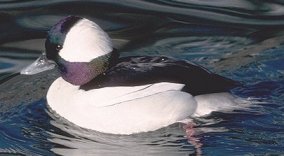
| Bufflehead | |
| Scientific classification | |
| Kingdom: | Animalia |
| Phylum: | Chordata |
| Class: | Aves |
| Order: | Anseriformes |
| Family: | Anatidae |
| Subfamily: | various |
Duck is the common name for a number of species in the Anatidae family of birds. The ducks are divided between several subfamilies in the Anatidae family; they do not represent amonophyletic group but a form taxon, since swans and geese are not considered ducks. Ducks are mostly aquatic birds, mostly smaller than the swans and geese, and may be found in both fresh water and sea water.
Ducks are sometimes confused with several types of unrelated water birds with similar forms, such as loons or divers, grebes, gallinules, and coots.
Etymology

The word duck comes from Old English *dūce "diver", a derivative of the verb *dūcan "to duck, bend down low as if to get under something, or dive", because of the way many species in the dabbling duck group feed by upending; compare with Dutch duiken and German tauchen "to dive".
This word replaced Old English ened/ænid "duck", possibly to avoid confusion with other Old English words, like ende "end" with similar forms. Other Germanic languages still have similar words for "duck", for example, Dutch eend "duck" and German Ente "duck". The word ened/ænid was inherited from Proto-Indo-European; compare: Latin anas "duck", Lithuanian ántis "duck", Ancient Greeknēssa/nētta (νήσσα, νήττα) "duck", and Sanskrit ātí "water bird", among others.
Some people use "duck" specifically for adult females and "drake" for adult males, for the species described here; others use "hen" and "drake", respectively.
A duckling is a young duck in downy plumage[1] or baby duck.[2]; but in the food trade young adult ducks ready for roasting are sometimes labelled "duckling".
Morphology

The overall body plan of ducks is elongated and broad, and the ducks are also relatively long-necked, albeit not as long-necked as the geese and swans. The body shape of diving ducks varies somewhat from this in being more rounded. The bill is usually broad and contains serrated lamellae which are particularly well defined in the filter-feeding species. In the case of some fishing species the bill is long and strongly serrated. The scaled legs are strong and well developed, and generally set far back on the body, more so in the highly aquatic species. The wings are very strong and are generally short and pointed, and the flight of ducks requires fast continuous strokes, requiring in turn strong wing muscles. Three species of steamer duck are almost flightless, however. Many species of duck are temporarily flightless while moulting; they seek out protected habitat with good food supplies during this period. This moult typically precedes migration.
The drakes of northern species often have extravagant plumage, but that is moulted in summer to give a more female-like appearance, the "eclipse" plumage. Southern resident species typically show less sexual dimorphism, although there are exceptions like the Paradise Shelduck of New Zealand which is both strikingly sexually dimorphic and where the female's plumage is brighter than that of the male. The plumage of juvenile birds generally resembles that of the female.
Behaviour
Feeding

Ducks exploit a variety of food sources such as grasses, aquatic plants, fish, insects, small amphibians[3], worms, and small molluscs.
Diving ducks and sea ducks forage deep underwater. To be able to submerge more easily, the diving ducks are heavier than dabbling ducks, and therefore have more difficulty taking off to fly.
Dabbling ducks feed on the surface of water or on land, or as deep as they can reach by up-ending without completely submerging.[4] Along the edge of the beak there is a comb-like structure called a pecten. This strains the water squirting from the side of the beak and traps any food. The pecten is also used to preen feathers.
A few specialized species such as the smew, goosander, and the mergansers are adapted to catch and swallow large fish.
The others have the characteristic wide flat beak designed for dredging-type jobs such as pulling up waterweed, pulling worms and small molluscs out of mud, searching for insect larvae, and bulk jobs such as holding and turning headfirst and swallowing a squirming frog. To avoid injury when digging into sediment it has no cere. but the nostrils come out through hard horn.
Breeding

The ducks are generally monogamous, although these bonds generally last a single year only. Larger species and the more sedentary species (like fast river specialists) tend to have pair-bonds that last numerous years. Most duck species breed once a year, choosing to do so in favourable conditions (spring/summer or wet seasons). Ducks also tend to make a nest before breeding.
Communication
Despite widespread misconceptions, only the females of most dabbling ducks "quack". For example, the scaup – which are diving ducks – make a noise like "scaup" (hence their name), and even among the dabbling ducks, the males never quack. In general, ducks make a wide range of calls, ranging from whistles cooing, yodels and grunts. Calls may be loud displaying calls or quieter contact calls.
A common urban legend claims that duck quacks do not echo; however, this has been shown to be false. This myth was first debunked by the Acoustics Research Centre at the University of Salfordin 2003 as part of the British Association's Festival of Science.[5] It was also debunked in one of the earlier episodes of the popular Discovery Channel television show MythBusters.[6]
Ecology

Distribution and habitat
The ducks have a cosmopolitan distribution occurring across most of the world except for Antarctica. A number of species manage to live on sub-Antarctic islands like South Georgia and theAuckland Islands. Numerous ducks have managed to establish themselves on oceanic islands such as Hawaii, New Zealand and Kerguelen, although many of these species and populations are threatened or have become extinct.

Some duck species, mainly those breeding in the temperate and Arctic Northern Hemisphere, are migratory; those in the tropics, however, are generally not. Some ducks, particularly in Australia where rainfall is patchy and erratic, are nomadic, seeking out the temporary lakes and pools that form after localised heavy rain.[citation needed]
Ducks have become an accepted presence in populated areas. Migration patterns have changed such that many species remain in an area during the winter months. In spring and early summer ducks sometimes influence human activity through their nesting; sometimes a duck pair nests well away from water, needing a long trek to water for the hatchlings: this sometimes causes an urgentwildlife rescue operation (e.g. by the RSPCA) if the duck nested somewhere unsuitable like in a small enclosed courtyard.
Predators

Worldwide, ducks have many predators. Ducklings are particularly vulnerable, since their inability to fly makes them easy prey not only for predatory birds but also large fish like pike, crocodilians, and other aquatic hunters, including fish-eating birds such as herons. Ducks' nests are raided by land-based predators, and brooding females may be caught unaware on the nest by mammals such as foxes, or large birds, such as hawks or eagles.
Adult ducks are fast fliers, but may be caught on the water by large aquatic predators including big fish such as the North American muskie and the European pike. In flight, ducks are safe from all but a few predators such as humans and the Peregrine Falcon, which regularly uses its speed and strength to catch ducks.
Relationship with humans
Domestication

Ducks have many economic uses, being farmed for their meat, eggs, feathers, (particularly their down). They are also kept and bred by aviculturists and often displayed in zoos. All domestic ducks are descended from the wild Mallard Anas platyrhynchos, except the Muscovy Duck [7]. Many domestic breeds have become much larger than their wild ancestor, with a "hull length" (from base of neck to base of tail) of 30 cm (12 inches) or more and routinely able to swallow an adult British Common Frog Rana temporaria whole; the wild mallard's "hull length" is about 6 inches.
FAO reports that China is the top duck market in 2004 followed by Vietnam and other South East Asian countries.
In many areas, wild ducks of various species (including ducks farmed and released into the wild) are hunted for food or sport, by shooting, or formerly by decoys. Because an idle floating duck or a duck squatting on land cannot react to fly or move quickly, "a sitting duck" has come to mean "an easy target".
Wild ducks of many species and domesticated breeds are widely consumed around the world.
Cultural references

In 2002, psychologist Richard Wiseman and colleagues at the University of Hertfordshire, UK, finished a year-long LaughLab experiment, concluding that of all animals, ducks attract the most humor and silliness; he said "If you're going to tell a joke involving an animal, make it a duck."[8] The word "duck" may have become an inherently funny word in many languages possibly because ducks are seen as silly in their looks or behavior. Of the many ducks in fiction, many are cartoon characters like Donald Duck, who appeared in a Walt Disney film for the first time on 9 June 1934, and Daffy Duck, who appeared in Warner Brothers films.
yellribb.mp3


EVEN THE WORLD WILL SINK I WILL NEVER SINK UNLESS I DIE!

Ducks are a lot of fun. Here is our collection of duck jokesTake a look below...
*Why did the duck cross the road?
***What do physics ducks say? ****Why did the basketball player bring a duck to the game? | Duck Trivia Questions... Where is the biggest duck in the world? Cut and paste this link into your address bar to find out... http://fortuna.home.pipeline.com/cafe-compendium/duck.htm |
| So, a duck walked into a bar, and asked the bartender, "Do you have any grapes?" The bartender replied, "No, this isn't a grocery store, get the hell out of here!" So, the duck came back the next day, and asked the bartender "Do you have any grapes?" The bartender said "No, I told you before, this isn't a grocery store, and I don't have any grapes, now leave!" So the duck came back the next day, and asked the bartender, "Do you have any grapes?" The angry bartender said, "NO! And if you come back and ask me that again, I will nail your butt to the wall! Now leave!" So, the duck came back the next day, and asked the bartender, "Do you have any nails?" The bartender, puzzled, said, "No, why?" The duck said, "In that case, do you have any grapes?" |
In a software design meeting, we were using typical technical jargon to discuss a data exchange interface with a vendor. One co-worker said the programming we had ordered was delayed because the vendor was suffering from a "severe nonlinear waterfowl issue." Curious, the team leader raised his eyebrows and asked, " What exactly is that?" The programmer replied, "They don't have their ducks in a row." |
|
|
"What is your name?" he asked. "Quack." the duck answered. "And why were you arrested?" the judge asked. "I was stepping on bubbles." he answered. The judge didn't see anything wrong with that, so he dismissed the duck and called up the next one. "What's your name?" he asked. "Quack," the duck answered. "Why were you arrested?" the Judge asked. "I was stepping on bubbles." the duck replied. Again, the judge saw nothing offensive, so he called up the next duck. "What's your name?? No wait, let me guess, Quack." he said. "No," said the duck, "My name is Bubbles." |
A duck walks into a pub and orders a pint of lager and a ham sandwich. The landlord looks at him and says, "But you're a duck!" "And you talk!" exclaims the landlord. "And your ears", says the duck, "Certainly", says the landlord, "sorry about that... it's just we don't get many ducks in this pub. What are you doing round this way?". "I'm working on the building site across the road", explains the duck. The landlord watches, astounded, as the duck drinks his beer, eats his sandwich and leaves. The duck visits regularly for 2 weeks. Then one day the circus comes to town. The owner of the circus comes into the pub and the landlord says to him, "Sounds marvellous", says the owner, "get him to give me a call". So the next day when the duck comes into the pub the landlord says, "Yeah?", says the duck, "Sounds great, where is it?". "At the circus", says the landlord. "The circus?", the duck enquires, a bit bemused. "That's right", replies the landlord. "What, the place with the big tent?. Big canvas roof, hole in the middle, loads of animals?", asks the duck. "That's right!", says the landlord. The duck looks confused. "Why would they want a plasterer" |
|
| I have two ducks that I use as an alarm clock. They wake me up at the Quack of dawn. |

Ducks are birds. They are also called "waterfowls" because they are normally found in places with water, like ponds, streams and rivers. They are related to geese and swans. The duck is the smallest of them all. Ducks also have shorter necks and wings and a stout body. They can live from 2-12 years, depending on breed.

Ducks have webbed feet, designed for swimming. Their webbed feet act like paddles for the ducks. A duck waddles instead of walks because of its webbed feet. Do you know that the duck's feet cannot feel cold even if it swims in icy cold water? Well, the reason for this is because its feet have no nerves or blood vessels!
Another special thing that the duck has is its water-proof feathers. There is a special gland that produces oil near the duck's tail which spreads and covers the outer coat of the duck's feathers, making it water-proof. Beneath the water-proof coat are fluffy and soft feathers to keep the duck warm.
How does a duck clean itself ?
Ducks keep clean by preening themselves. They do this by being able to turn their heads completely backwards, and putting their beaks into the feathers on their wings, breast and back. They preen themselves very often.
Do you know what does a duck say ?
Ducks give out a special sound. Listen to the sound of ducks quacking here. However, not all ducks quack. The Wood Duck does not quack, it gives out a "squeal" instead.
Ducks were once wild until they were domesticated by the Chinese over 1,000 There are still many different breeds of wild ducks. 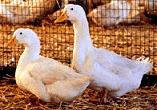 Most of the farm ducks are of a breed called "Pekin". It is harder to tell a male from a female with the Pekin ducks because they look almost the same. The male has two to three curly feathers on top. Pekin ducks have white or cream colored feathers and orange colored bills. These ducks do not fly and do well in captivity. They are also excellent for egg and meat production. The Pekin duck originated from China and is the most popular breed in the United States, having been first brought by ship from China to Long Island, New York in 1873.
Ducks are found in wetlands, marshes, ponds, rivers, lakes and oceans. This is because ducks love the water. Some species of ducks migrate or travel longs distances every year to breed. Usually they travel to warmer areas or where the water does not freeze so that they can rest and raise their young. The distance may be thousands of miles away. Ducks are found everywhere in the world except the Antarctica which is too cold for them.
How they hunt for food ?
The duck's mouth is called a "bill". Normally, it is broad and flat and has rows of fine notches along the edge called "lamellae". The lamellae helps the duck to grip its food so that it will not slip off. However, ducks bills come in different shapes and sizes. The shape of the bill and body features will determine how the duck hunt for its food.
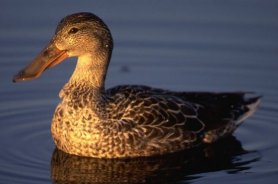
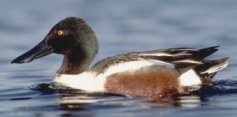
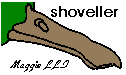 Ducks which have broad beaks, sift their food for insects, snails and seeds from the mud. These are called the shovelers. The Northern Shoveler is an example.
Female Northern Shoveler
Male Northern Shoveler
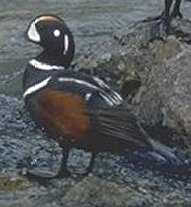
 Some ducks have long and narrow beaks. The narrow beaks are also covered will with saw-like edges which help them to grab fish. Sea ducks usually have this kind of beak. Sea ducks are also divers. Examples are the Mergansers, Eiders, Harlequins, Goldeneyes and Buffleheads.
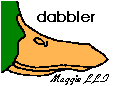 Some ducks do not dive for food. Their beaks are broad and short. They are called dabbling ducks or dabblers. They eat plants, seeds, grasses, small insects and animals that they find on or under the water.
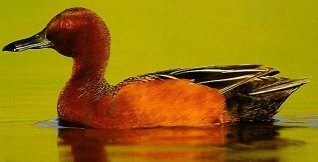
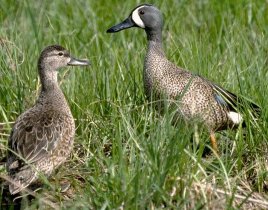
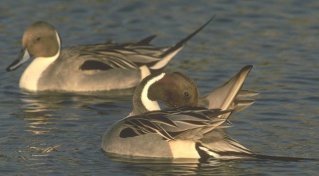
 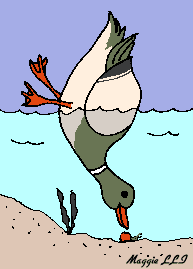 Usually they up-ends and stretch their heads into the water to reach their food. Dabblers usually have shiny colored patches on their wings. The domestic ducks are dabblers too. They are descendents of the Mallards. Dabbling ducks take off from the water in quick jumps. Examples of dabbling ducks are the mallards, cinnamon teals, shovellers, green and blue-winged teals, pintails, black ducks, baldpates and gadwalls.
Ducks with long necks dive their head down into the shallow water and pick up their food.
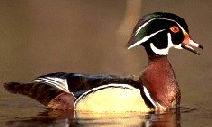
Ducks of different breeds look different. Some are very colorful like the Perching ducks. They are called Perching ducks because they like to perch or rest in trees. Perching ducks are found in North America, tropical regions of Asia, Africa, Central and South America. Examples of Perching ducks are the Wood Ducks, Muscovy Ducks and Mandarin Ducks.
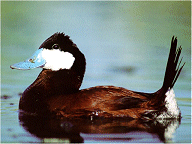
Another breed is the "Stiff-tailed" duck. Examples are the Ruddy Duck and the Masked Duck.
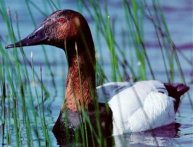
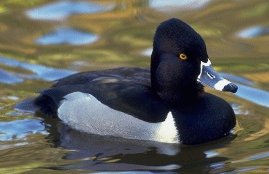
Ducks that come under the Pochards breed are the Canvasbacks, Ringnecks, Redheads and Lesser Scaups. They swim underwater with their wings closed and their legs sticking out to the sides. Their legs are closer to the rear end of their body compared to the other breeds of ducks. They run on the water surface before they lift-off and fly, just like an airplane!
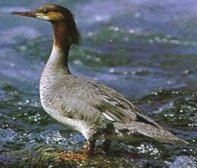
The sea ducks' bills does not look like a duck's bill. It is long and narrow with sawlike edges for catching and holding on to a fish. Example is the Merganser.
Different Duck Species
Which is the male and which is the female ?
The males (drakes) are usually the brightly colored ones while the females (ducks) are usually a dull-colored brown so that they can hide be camouflaged from their enemies when they are in their nests.
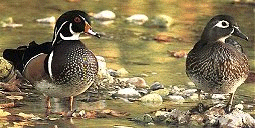
Wood duck pair.
Ducks usually look for a mate or partner in winter. The males will attract the females with their colorful plumage or feathers. The females will then lead the males to their breeding ground in spring. Instinctively, the breeding ground will usually be the place where she was hatched � it�s as if they have a built-in homing device. The female builds her nest with grass or reeds or even in a hole in a tree. The male will guard their territory by chasing away other couples. Once the female lays 5-12 eggs, she will start to sit on her eggs to keep it warm so that they can hatch into ducklings. The males on the other hand, will be with the other males. The eggs will hatch within 28 days normally, except for the Muscovy which takes about 35 days to hatch.
The mother duck will keep her brood of ducklings together to protect them from predators. Animals like the raccoon, turtles, hawks, large fish and snakes will eat the ducklings. Ducklings are able to fly within 5-8 weeks. Their feathers develop really fast. When the young are ready to fly, all the ducks will gather in flocks on large lakes, marshes or the ocean to migrate to their wintering home. When the ducks fly, they usually do so in a "V-shaped" formation or a long line.
Do you know what affects duck's production of eggs ?
The production of eggs is affected by daylight. When there is more daylight, the ducks will lay more eggs. In the months of July to December when daylight is short, they slow down their production of eggs. Sometimes, they stop laying eggs completely during these months. To prevent this from happening, farmers use artificial lighting so that the ducks have about 17 hours of light a day to produce eggs efficiently.
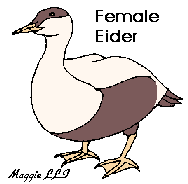 Ducks, like other animals, are useful to human beings. They provide us with eggs and meat to eat. Some ducks provide us with feathers are used for stuffing quilts and pillows. The feathers are usually from the Eider duck. Thus, the name "eiderdown" for stuffed quilts. To line their nests, the females pluck feathers from their breast. Their feathers are harvested in Iceland where they are found everywhere along the coast and are a valuable source of income for the people here. Eiders feed on mussels, sea snails, crabs, shrimps, barnacles, catch fish, dig for snails and eat other small crustaceans and some sea-weeds.
MORE DUCK INFO! Photo © Terry Danish For information on raising ducklings, go to Raising Ducklings and Goslings. Duck eggs take 28-30 days to hatch, except for Muscovy eggs, which take 35 days. If you find a wild duck's nest on your property and don't see the mother on the eggs, don't necessarily worry. Ducks lay an egg every day or two until they have a full clutch (usually 8 to 15); only then will the mother start to sit on them. It takes the eggs 28 days to hatch from when she starts sitting all the time. When they hatch, she will soon lead them to a nearby body of water. The father takes no part in caring for the eggs or young. Another question I'm commonly asked is about sexing them. This is pretty easy for all the Mallard-derived ducks (all the domestics except Muscovies); there are two main clues. First is that, by about 10 weeks of age, the voice of the female is a loud quack, while that of the male is soft and whispery. Second, later on the males develop a curled feather (the drake feather) on top of the tail. In Muscovies, by three months or so, the males are nearly twice as large as the females. I've found that in younger Muscovies, the feet of the males are often relatively larger, but I don't know if you can count on this. Very young ducklings have to be vent sexed. For info and pictures see the waterfowl books described on my Book Page. Although domestic ducks (except for Muscovies) are all descended from Mallards (Anas platyrhynchos), most of them have been bred so that their bodies are too heavy and wings too small to support flying. Of the mallard-derived breeds, only Calls and some of the other bantam ducks can fly. Muscovies also can fly well, especially the females. Male Muscovies can lumber up in the air and flap about a bit, but they sure don't remind me of birds! Note that most Mallard-colored drakes, and some of other colors, undergo an Eclipse molt in late summer, after which they are colored like females. They will molt again into male colors later in the year. A Runner drake in normal plumage (left) and eclipse plumage (right) Colour Breeding in Domestic Ducks by Mike and Chris Ashton, 2007, 48 pp., Welshpool Printing Group, available from www.ashtonwaterfowl.net, ISBN: 978-0-9555642-0-8. If you are a waterfowl breeder, please complete the SPPA's Domestic Waterfowl Survey.


Photos courtesy of Jacob McConnell
If you want to know about breeding and the genetics of the Mallard-derived domestic ducks, this book is a must for your library!
All of the Peking (Pekin) ducks in the U.S. are descended from 9 ducks imported to Long Island, New York in 1873. (also called Long Island duckling) The Labrador Duck was the first endemic North American bird species to be hunted to extinction. The last known Labrador Duck was shot near the shore of Long Island, New York in 1875. The Muscovy Duck, is a greenish black duck with red wattles, found wild in Mexico and northern South America. The Muscovy was domesticated in South America before the arrival of Columbus. The Muscovy duck and the wild Mallard duck are believed to be the ancestors of modern domestic ducks. Most people think about turkey for Thanksgiving, but in Stuttgart, Arkansas, the World Championship Duck Calling Contest takes place Thanksgiving week. More than 60,000 people attend the festival, which is the oldest in the state. The first duck-calling contest, held in 1936, had 17 contestants, with the first prize of a hunting coat valued at $6.60. Today the contest is held in six divisions, including junior, intermediate, and women, and the prize package is worth more than $15,000.DUCKS: DUCK TRIVIA
There are about 24 million ducks raised each year in the U.S., and Maple Leaf Farms in California, Wisconsin and Indiana produce almost 2/3rds of them.
Bombay duck is really a small (up to 16 inches) edible lizardfish which in India is salted then sun dried and used as a condiment. It is also used as a food fish in many areas of southern Asia. Also known as bumalo and bombila .
Muscovy ducks are raised to 11 weeks. They are most often selected for their breast meat and liver, which is used to make foie gras. Moulard is a cross between a male Muscovy and a female White Pekin. Like Muscovy, Moulard ducks are most often used for foie gras. Muscovy comprises 3 to 4 percent of U.S. duck consumption; Moulard 1 to 2 percent.
There are three major duckling breeds available in the United States: White Pekin, Muscovy, and Moulard. National consumption increased by 21.3 percent between 1995 and 2000—a percentage increase that outpaces chicken and turkey
White Pekin is the best selling duckling, comprising roughly 95 percent of U.S. duckling consumption. White Pekin duckling are generally raised to 6 to 8 weeks for optimal tenderness.
White Pekin is known for its mild, satisfying flavor that easily adapts into a number of cuisine and menu categories.
White Pekin has a nutritional make-up that still surprises most people. Nutritional information released by the USDA in 1997 proves that skinless White Pekin duckling breast is lower in fat and calories than skinless chicken breast.
There are four basic types of duck calls. The 'hail call' is a series of loud, pleading quacks that attract a flock's attention. Once you see ducks react to the hail, either by turning or slowing down, stop hailing them. As the ducks get closer, switch to a 'greeting call,' a series of five excited quacks. Then you use the 'feed call' when they get close. Done properly, it mimics a group of contented ducks on the water. If the ducks are leaving, try the 'come-back call.' It's similar to the greeting call, but with louder, longer, pleading quacks. If your come-back call makes the ducks turn around, go back to the feed call. All of this quacking may sound easy, but it isn't. Just try it and see!
duck
1 Show IPA
DUCK EGGS
When duck eggs are boiled, the white turns bluish and the yolk turns a reddish orange.
Duck eggs have a richer, oilier taste than chicken eggs.
Suggestions for using duck eggs:
1) Hard boiled: boil them for 10 to 15 minutes (pretty boring)
2) Boil them for 10 minutes, then carefully crack the shell without peeling it - then simmer it in tea for about 1 hour.
Or simmer them in 8 cups water, 1/2 cup soy sauce, 1 TB honey, 2 pieces orange or tangerine zest, 2 fresh garlic cloves and a pinch of salt for 2 hours.
3) Ming Dynasty eggs, fermented eggs, ancient eggs, century eggs, thousand year old eggs, and hundred year old eggs. These are all names for the Chinese preserved (usually Duck) eggs. They are really only about 50 to 100 days old. The eggs are covered with a coating of lime, ashes, salt and rice straw and buried in shallow holes for up to 100 days. The lime petrifies the egg making it look very old. The yolks turn amber to black with a creamy dark green yolk. They are eaten uncooked with soy sauce and minced ginger.
Donald Duck
 | This article needs additional citations for verification. Please help improve this article by adding reliable references. Unsourced material may be challenged and removed. (February 2008) |
| Donald Duck | |
|---|---|
 | |
| First appearance | The Wise Little Hen (Silly Symphonies), 1934[1] |
| Created by | Dick Lundy |
| Voiced by | Clarence Nash (1934–1985) Tony Anselmo (1985–present) |
| Aliases | Paperinik |
| Relatives | Ludwig Von Drake (uncle) Scrooge McDuck (uncle) Huey, Dewey, and Louie(nephews) Grandma Duck (grandmother) Bertie Duck (aunt) Della Duck (sister) Quackmore Duck (father) Hortense McDuck (mother) Duffy Duck (brother) Gus Goose (second cousin) |
Donald Fauntleroy Duck is an American cartoon character from The Walt Disney Company. Donald is a white anthropomorphic duck with a yellow-orange bill, legs, and feet. He usually wears asailor shirt, cap, and a red bow tie, but no trousers (except when he goes swimming). Donald's most famous personality trait is his easily provoked and explosive temper. Donald Duck has been officially honored as the third most popular cartoon character of all time with Bugs Bunny of Warner Bros. Looney Tunes/Merrie Melodies at number two and fellow Disney creation Mickey Mousewho is number one.[citation needed]
According to the Disney canon, particularly in the 1942 short Donald Gets Drafted Donald's birthday is officially recognized as June 9, 1934,[2] the day his debut film, The Wise Little Hen, was released. However, in The Three Caballeros (1944), his birthday is given as simply "Friday the 13th", which is in reference to the bad luck he experiences in almost all his cartoon appearances.Donald's Happy Birthday (short) gives his birthday as March 13. The 1942 short "Donald Gets Drafted", as well as the Quack Pack episode "All Hands on Duck", also reveals his full name to be Donald Fauntleroy Duck.[3] Donald Duck is a well-known and very popular character especially in Scandinavian countries.[4] Donald's 1942 short film, Der Fuehrer's Face, won the Academy Award for Animated Short Film.
Donald's voice, one of the most identifiable voices in all of animation, was performed by voice actor Clarence "Ducky" Nash up to his death in 1985. It was largely this semi-intelligible speech that would cement Donald's image into audiences' minds and help fuel both Donald's and Nash's rise to stardom.[citation needed] In 1969, Disney On Parade which toured all over the United States and Canada, hired Ellard Davis as the live voice of Donald Duck. Mr. Davis did the voice for 3 years. Since 1985, Donald has been voiced by Tony Anselmo, who was trained by Nash for the role.[citation needed]
[edit]Donald in animation
[edit]Early appearances

According to Leonard Maltin in his introduction to The Chronological Donald - Volume 1, Donald was created by Walt Disney when he heard Clarence Nash doing his "duck" voice while reciting "Mary had a little lamb". Mickey Mouse had lost some of his edge since becoming a role model for children and Disney wanted a character that could portray some of the more negative character traits he could no longer bestow on Mickey.
Donald Duck first appeared in the Silly Symphonies cartoon The Wise Little Hen on June 9, 1934 (though he is mentioned in a 1931 Disney storybook). Donald's appearance in the cartoon, as created by animatorDick Lundy, is similar to his modern look—the feather and beak colors are the same, as is the blue sailor shirt and hat—but his features are more elongated, his body plumper, and his feet smaller. Donald's personality is not developed either; in the short, he only fills the role of the unhelpful friend from the original story.
Burt Gillett, director of The Wise Little Hen, brought Donald back in his Mickey Mouse cartoon, Orphan's Benefit on August 11, 1934. Donald is one of a number of characters who are giving performances in a benefit for Mickey's Orphans. Donald's act is to recite the poems Mary Had a Little Lamb and Little Boy Blue, but every time he tries, the mischievous orphans heckle him, leading the duck to fly into a squawking fit of anger. This explosive personality would remain with Donald for decades to come.
Donald continued to be a hit with audiences. The character began appearing regularly in most Mickey Mouse cartoons. Cartoons from this period, such as the 1935 cartoon The Band Concert—in which Donald repeatedly disrupts the Mickey Mouse Orchestra's rendition of The William Tell Overture by playing Turkey in the Straw—are regularly hailed by critics as exemplary films and classics of animation. Animator Ben Sharpsteen also minted the classic Mickey, Donald, and Goofy comedy in 1935, with the cartoon Mickey's Service Station.
In 1936, Donald was redesigned to be a bit fuller, rounder, and cuter. He also began starring in solo cartoons, the first of which was the January 9, 1937 Ben Sharpsteen cartoon, Don Donald. This short also introduced a love interest of Donald's, Donna Duck, who evolved into Daisy Duck.[5] Donald's nephews, Huey, Dewey and Louie, would make their first animated appearance a year later in the April 15, 1938 film,Donald's Nephews, directed by Jack King (they had been earlier introduced in the Donald Duck comic strip by Al Taliaferro, see below). By 1938, at most, polls showed that Donald was more popular than Mickey Mouse.[6] Disney could, however, help Mickey regain popularity by redesigning him, giving him his most appealing design as production for the Fantasia segment "The Sorcerer's Apprentice" began in 1938.[7]
[edit]Wartime Donald

Several of Donald's shorts during the war were propaganda films, most notably Der Fuehrer's Face, released on January 1, 1943. In it, Donald plays a worker in an artillery factory in "Nutzi Land" (Nazi Germany). He struggles with long working hours, very small food rations, and having to salute every time he sees a picture of the Führer (Adolf Hitler). These pictures appear in many places, such as on the assembly line in which he is screwing in the detonators of various sizes of shells. In the end he becomes little more than a small part in a faceless machine with no choice but to obey until he falls, suffering a nervous breakdown. Then Donald wakes up to find that his experience was in fact a nightmare. At the end of the short Donald looks to the Statue of Liberty and the American flag with renewed appreciation. Der Fuehrer's Face won the 1942 Academy Award for Animated Short Film. Der Fuehrer's Face was also the first of two animated short films to be set during the War to win an Oscar, the other being Tom & Jerry's short film, The Yankee Doodle Mouse. Other notable shorts from this period include the Army shorts, seven films that follow Donald's life in the US Army from his drafting to his life in basic training under sergeant Pete to his first actual mission as a commando having to sabotage a Japanese air base. Titles in the series include:
- Donald Gets Drafted – (May 1, 1942).
- The Vanishing Private – (September 25, 1942).
- Sky Trooper – (November 8, 1942).
- Fall Out Fall In – (April 23, 1943).
- The Old Army Game – (November 5, 1943).
- Home Defense – (November 26, 1943).
- Commando Duck – (June 2, 1944).
Donald Gets Drafted also featured Donald having a physical examination before joining the army. According to it Donald has flat feet and is unable to distinguish between the colors green and blue, which is a type of color blindness. Also in this cartoon sergeant Pete comments on Donald's lack of discipline.
It is also noteworthy that thanks to these films, Donald graced the nose artwork of virtually every type of WWII Allied combat aircraft, from the L-4 Grasshopper to the B-29 Superfortress.
Donald also appears as a mascot—such as in the Army Air Corps 309th Fighter Squadron[8] and the U.S. Coast Guard Auxiliary, which showed Donald as a fierce-looking pirate ready to defend the American coast from invaders.[9] Donald also appeared as a mascot emblem for: 415th Fighter Squadron; 438th Fighter Squadron; 479th Bombardment Squadron; 531st Bombardment Squadron.
During World War II, Disney cartoons were not allowed to be imported into Occupied Europe. Since this cost Disney a lot of money, he decided to create a new audience for his films in South America. He decided to make a trip through various Latin American countries with his assistants, and use their experiences and impressions to create two feature length animation films. The first was Saludos Amigos, which consisted of four short segments, two of them with Donald Duck. In the first, he meets his parrot pal Jose Carioca. The second film was The Three Caballeros, in which he meets his rooster friend Panchito.
[edit]Post-war animation
Many of Donald's films made after the war recast the duck as the brunt of some other character's pestering. Donald is repeatedly attacked, harassed, and ridiculed by his nephews, by the chipmunks Chip 'n Dale, or by other one-shot characters such as Humphrey the Bear, Spike the Bee, Bootle Beetle, the Aracuan Bird, Louie the Mountain Lion, or a colony of ants. In effect, the Disney artists had reversed the classic screwball scenario perfected by Walter Lantz and others in which the main character is the instigator of these harassing behaviors, rather than the butt of them.
The post-war Donald also starred in educational films, such as Donald in Mathmagic Land and How to Have an Accident at Work (both 1959), and made cameos in various Disney projects, such as The Reluctant Dragon (1941) and theDisneyland television show (1959). For this latter show, Donald's uncle Ludwig von Drake was created in 1961.
Clarence Nash voiced Donald for the last time in Mickey's Christmas Carol (1983), making Donald the only character in the film to be voiced by his original actor. Since Nash's death in 1985, Donald's voice has been provided by Tony Anselmo, who was mentored by Nash. Anselmo's voice is heard for the first time in Who Framed Roger Rabbit?. In this movie, Donald has a piano duel scene with the Warner Brothers duck Daffy Duck voiced by Mel Blanc and wins the duel with a cartoon cannon.
Donald has since appeared in a lot of different television shows and (short) animated movies. He played roles in Mickey's Christmas Carol and The Prince and the Pauper and made a cameo appearance in A Goofy Movie.
Donald had a rather small part in the animated television series DuckTales. There, Donald joins the Navy, and leaves his nephews Huey, Dewey, and Louie with their Uncle Scrooge, who then has to take care of them. Donald's role in the overall series was fairly limited, as he only ended up appearing in a handful of episodes. Some of the stories in the series were loosely based on the comics by Carl Barks.
Donald made some cameo appearances in Bonkers, before getting his own television show Quack Pack. This series featured a modernized Duck family. Donald was no longer wearing his sailor suit and hat, but a Hawaiian shirt. Huey, Dewey, and Louie now are teenagers, with distinct clothing, voices, and personalities. Daisy Duck has lost her pink dress and bow and has a new hairdo. Oddly enough, no other family members, besides Ludwig von Drake, appear in Quack Pack, and all other Duckburg citizens are humans, and not dogs.
He made a comeback as the star of the "Noah's Ark" segment of Fantasia 2000, as first mate to Noah. Donald musters the animals to the Ark and attempts to control them. He tragically believes that Daisy has been lost, while she believes the same of him, but they are reunited at the end. All this to Edward Elgar's Pomp and Circumstance Marches 1o4.
In an alternate opening for the 2005 Disney film Chicken Little, Donald would have made a cameo appearance as "Ducky Lucky". This scene can be found on the Chicken Little DVD.
Donald also played an important role in Mickey Mouse Works and House of Mouse. In the latter show, he is the co-owner of Mickey's night club.
[edit]Characterization
[edit]Personality
Donald's dominant personality trait is his short temper and, in contrast, his positive look on life. Many Donald shorts start with Donald in a happy mood, without a care in the world, until something comes and spoils his day. His anger is a great cause of suffering in the duck's life, and he has on multiple occasions got in over his head and lost competitions because of it. There are times when he fights to keep his temper, and he has succeeded a few times, but he always returns to his well known, aggressive self at the end of the day. Donald's aggressive nature is a double-edged sword however, and while it at times is a hindrance and even a handicap for him, it has also helped him in times of need. When faced against a threat of some kind, Donald may get frightened and even intimidated (mostly by Pete), but rather than getting scared, he gets mad and has taken up fights with ghosts, sharks, mountain goats and even the forces of nature. And, more often than not, Donald has come out on top.
Donald can at times be a bit of a bully and a tease, especially against his nephews and Chip 'n Dale. As animator Fred Spencer once wrote:
The Duck gets a big kick out of imposing on other people or annoying them, but he immediately loses his temper when the tables are turned. In other words, he can dish it out, but he can't take it.[10]
However, there is seldom any malice in Donald's pranks. He is never out to hurt anyone, and if he ever goes too far in his pranks he is always very regretful. In Truant Officer Donald, for example, when he is tricked into believing he accidentally killed Huey, Dewey and Louie he shows great remorse, blaming himself and willingly takes a kick handed out by one of the “angel” nephews. That is, of course, until he realizes he has been played a sap and directly loses his temper.
Donald has also been shown to be a bit of a show-off. He likes to brag, especially when he is very skilled at something. This has a tendency to get him into trouble, however, as he also tends to get in over his head. Still, Donald has proven that he is a Jack of all Trades and are, among other things, a good fisher and hockey player.
Last, but not least, among his personality traits is his stubbornness and commitment. Even though Donald at times can be lazy, and he has stated many times that his favorite place is in the hammock, once he has committed to something he goes in for it 100%, sometimes going to extreme measures to reach his goal. 'Cause even though Donald isn't the most lucky character there is, in fact, he has a tendency to “get stuck with all the bad luck”, he never gives up and if someone knocks him down, he always gets right up again.
[edit]Phrases
Donald has a few memorable phrases that he occasionally comes out with in given situations. "What's the Big Idea!?" is a common one, which Donald usually says when stumbling across other characters in the midst of planning some sort of retaliation or prank, and sometimes when certain things don't go as planned or don't work properly. "Aw Phooey!" is another memorable saying Donald makes, usually after giving up on a particular action or event. Another popular phrase Donald says, in particular to Daisy, is, "Hiya, toots!".
[edit]Health
A running gag in the Donald Duck comics is about his physical condition. Usually, some character close to Donald believes that because of his laziness, Donald needs to do some exercise, which annoys Donald. But, in spite of his apparent lazy condition, Donald proves that he is physically strong, as evidenced in one of his shorts, Sea Scouts, where Donald travels in a boat with his nephews, but a shark attacks the boat and Donald, after several misadventures, finally defeats the shark with a single punch.
[edit]Rivalry with Mickey Mouse
Through out his career, Donald has shown that he's jealous of Mickey and wants his job as Disney's greatest star. In the early Disney shorts, Mickey and Donald were partners, but by the time The Mickey Mouse Club aired on television, it was shown that Donald always wanted the spotlight. One animated short that rivaled the famous Mickey Mouse March song was showing Huey, Dewey, and Louie as Boy Scouts and Donald as their Scoutmaster at a cliff near a remote forestand Donald leads them in a song mirroring the Mouseketeers theme "D-O-N-A-L-D D-U-C-K-! Donald Duck!" The rivalry would cause Donald some problems, in a 1988 TV special, where Mickey is cursed by a sorcerer to become unnoticed, the world believes Mickey to be kidnapped. Donald Duck is then arrested for the kidnapping of Mickey, as he is considered to be the chief suspect, due to their rivalry. However, Donald did later get the charges dismissed, due to lack of evidence. Walt Disney, in his Wonderful World of Color, would sometimes make reference to the rivalry. Walt, one time, had presented Donald with a gigantic birthday cake and commented how it was "even bigger than Mickey's", which pleased Donald. The clip was rebroadcast in November 1984 during a TV special honoring Donald's 50th birthday.
The rivalry between Mickey and Donald has also been shown in Disney's House of Mouse. It was shown that Donald wanted to be the Club's founder and wanted to change the name from House of Mouse to House of Duck. However, in later episodes, Donald accepted that Mickey was the founder and worked with Mickey as a partner to make the club profitable.
Mickey Mouse has failed to realize how much Donald does not like him at times, and always counts him as one of his best friends. Despite the rivalry, Donald seems to be an honest friend of Mickey's, and will be faithful to him in tough situations, such as working with Mickey and Goofy as a team akin to The Three Musketeers. In the Kingdom Hearts games, Donald is quite loyal to Mickey, even briefly leaving Sora to follow King Mickey's orders.
The rivalry between Mickey and Donald is not unlike that of Warner Bros. characters Bugs Bunny and Daffy Duck, and many animation fans have commented on the parallels present among the four characters, the main difference being that Bugs actually realises that Daffy doesn't always like him, and uses this fact to play tricks on the duck.
[edit]Donald in comics
While Donald's cartoons enjoy vast popularity in the United States and around the world, his weekly and monthly comic books enjoy their greatest popularity in many European countries, especially Sweden, Denmark, Norway, Finland andIceland, but also Germany, Italy, the Netherlands, and Greece. Most of them are produced and published by the Italian branch of the Walt Disney Company in Italy and by Egmont in Denmark, Norway, Finland and Sweden. In Germany, the comics are published by Ehapa which has since become part of the Egmont empire. Donald-comics are also being produced in The Netherlands and France. Donald also has been appeared in Japanese comics published by Kodansha andTokyopop.
According to the INDUCKS, which is a database about Disney comics worldwide, American, Italian and Danish stories have been reprinted in the following countries. In most of them, publications still continue: Australia, Austria, Argentina,Belgium, Brazil, Bulgaria, Canada, the People's Republic of China, Colombia, Czech Republic, Denmark (Faroe Islands), Egypt, Estonia, Finland, France, Germany, Greece, Guyana, Hungary, Iceland, India, Indonesia, Israel, Italy, Japan,Latvia, Lithuania, Mexico, the Netherlands, Norway, Philippines, Poland, Portugal, Romania, Russia, Saudi Arabia, Slovakia, Spain, Sweden, Thailand, Turkey, the United Kingdom, the United States, and the former Yugoslavia.
[edit]Early development
Though a 1931 Disney publication called Mickey Mouse Annual mentioned a character named Donald Duck, the character's first appearance in comic-strip format was a newspaper cartoon that was based on the short The Wise Little Hen and published in 1934. For the next few years, Donald made a few more appearances in Disney-themed strips, and by 1936, he had grown to be one of the most popular characters in the Silly Symphonies comic strip. Ted Osborne was the primary writer of these strips, with Al Taliaferro as his artist. Osborne and Taliaferro also introduced several members of Donald's supporting cast, including his nephews, Huey, Dewey, and Louie.
In 1937, an Italian publisher named Mondadori created the first Donald Duck story intended specifically for comic books. The eighteen-page story, written by Federico Pedrocchi, is the first to feature Donald as an adventurer rather than simply a comedic character. Fleetway in England also began publishing comic-book stories featuring the duck.
[edit]Developments under Taliaferro
A daily Donald Duck comic strip drawn by Taliaferro and written by Bob Karp began running in the United States on February 2, 1938; the Sunday strip began the following year. Taliaferro and Karp created an even larger cast of characters for Donald's world. He got a new St. Bernard named Bolivar, and his family grew to include cousin Gus Goose and grandmother Elvira Coot. Donald's new rival girlfriends were Donna and Daisy Duck. Taliaferro also gave Donald his very own automobile, a 1934 Belchfire Runabout, in a 1938 story.
[edit]Developments under Barks

In 1942, Western Publishing began creating original comic-book stories about Donald and other Disney characters. Bob Karp worked on the earliest of these, a story called "Donald Duck Finds Pirate Gold". The new publisher meant new illustrators, however: Carl Barks and Jack Hannah. Barks would later repeat the treasure-hunting theme in many more stories.
Barks soon took over the major development of the comic-book version of the duck as both writer and illustrator. Under his pen, the comic version of Donald diverged even further from his animated counterpart, becoming more adventurous, less temperamental, and more eloquent. Pete was the only other major character from the Mickey Mouse comic strip to feature in Barks' new Donald Duck universe.
Barks placed Donald in the city of Duckburg, which he populated with a host of supporting players, including Gladstone Gander (1948), Gyro Gearloose (1952), Uncle Scrooge McDuck (1947), Magica de Spell (1961), Flintheart Glomgold (1956), the Beagle Boys (1951), April, May and June (1953), Neighbour Jones (1944) and John D. Rockerduck (1961). Many of Taliaferro's characters made the move to Barks' world as well, including Huey, Dewey, and Louie. Barks placed Donald in both domestic and adventure scenarios, and Uncle Scrooge became one of his favorite characters to pair up with Donald. Scrooge's popularity grew, and by 1952, the character had a comic book of his own. At this point, Barks concentrated his major efforts on the Scrooge stories, and Donald's appearances became more focused on comedy or he was recast as Scrooge's reluctant helper, following his rich uncle around the globe.
[edit]Further developments
Dozens of writers continued to utilize Donald in their stories around the world.
For example the Disney Studio artists, who made comics directly for the European market. Two of them, Dick Kinney (1917–1985) and Al Hubbard (1915–1984) created Donald's cousin Fethry Duck.
The American artists Vic Lockman and Tony Strobl (1915–1991), who were working directly for the American comic books, created Moby Duck. Strobl was one of the most productive Disney artists of all time, and drew a lot of stories which Barks wrote and sketched after his retirement. In the 1990s and early 2000s, these scripts were re-drawn in a style closer to Barks' own by Dutch artist Daan Jippes.
Italian publisher Mondadori created many of the stories that were published throughout Europe. They also introduced numerous new characters who are today well known in Europe. One example is Donald Duck's alter-ego, a superhero calledPaperinik in Italian, created by Guido Martina (1906–1991) and Giovan Battista Carpi (1927–1999).
Giorgio Cavazzano and Carlo Chendi created Honkey Go-Kart (Umperio Bogarto in Italian), a detective whose name is an obvious parody on Humphrey Bogart. They also created O.K Quack, an extraterrestrial Duck who landed on earth in a spaceship in the shape of a coin. He however lost his spaceship, and befriended Scrooge, and now is allowed to search through his moneybin time after time, looking for his ship.
Romano Scarpa (1927–2005), who was a very important and influential Italian Disney artist, created Brigitta McBridge, a female Duck who is madly in love with Scrooge. Her affections are never answered by him, though, but she keeps trying. Scarpa also came up with Dickie Duck, the granddaughter of Glittering Goldie (Scrooge's possible love-interest from his days in the Klondike) and Kildare Coot, a nephew of Grandma Duck.
Italian artist Corrado Mastantuono created Bum Bum Ghigno, a cynical, grumpy and not too good looking Duck who teams up with Donald and Gyro a lot.
The American artist William van Horn also introduced a new character: Rumpus McFowl, an old and rather corpulent Duck with a giant appetite and laziness, who is first said to be a cousin of Scrooge. Only later, Scrooge reveals to his nephews Rumpus is actually his half-brother. Later, Rumpus also finds out.
Working for the Danish editor Egmont, artist Daniel Branca (1951–2005) and script-writers Paul Halas and Charlie Martin created Sonny Seagull, an orphan who befriends Huey, Dewey and Louie, and his rival, Mr. Phelps.
The most productive Duck-artist today is Victor Arriagada Rios, who is better known under the name Vicar. He has his own studio where he and his assistants draw the stories sent in by Egmont. With writer/editors Stefan and Unn Printz-Påhlson, Vicar created the character Oona, a prehistoric duck princess who traveled to modern Duckburg by using Gyro's time-machine. She stayed, and is still seen in occasional modern stories.
The best-known and most popular Duck-artist of this time is American Don Rosa. He started doing Disney comics in 1987 for the American publisher Gladstone. He later worked briefly for the Dutch editors, but moved to work directly for Egmont soon afterwards. His stories contain many direct references to stories by Carl Barks, and he also wrote and illustrated a 12-part series of stories about the life of Scrooge McDuck, which won him two Eisner awards.
Other important artists who have worked with Donald are Freddy Milton and Daan Jippes, who made 18 ten-pagers which experts claim were very difficult to separate from Barks' own work from the late 1940s.
Japanese artist Shiro Amano worked with Donald on the graphic novel Kingdom Hearts based on the Disney-SquareEnix videogame.
[edit]Donald Duck outside the United States
Donald Duck has a worldwide presence, wherever Disney characters can be found, but in some countries he is very popular and takes on a unique character.
[edit]
| This section needs additional citations for verification. Please help improve this article by adding reliable references. Unsourced material may be challenged and removed. (January 2010) |
Donald Duck (Kalle Anka in Sweden, Anders And in Denmark, Andrés Önd in Iceland, Donald Duck in Norway and Aku Ankka in Finland) is a very popular character in Scandinavian countries. In the mid-1930s, Robert S. Hartman, a German who served as a representative of Walt Disney, visited Sweden to supervise the merchandise distribution of Sagokonst (The Art of Fables). Hartman found a studio called L'Ateljé Dekoratör, which produced illustrated cards that were published by Sagokonst. Since the Disney characters on the cards appeared to be exactly 'on-model', Hartman asked the studio to create a local version of the English-language Mickey Mouse Weekly. In 1937 L'Ateljé Dekoratör began publishingMusse Pigg Tidningen (Mickey Mouse Magazine), which had high production values and spanned 23 issues; most of the magazine's content came from local producers, while some material consisted of reprints from Mickey Mouse Weekly. The comic anthology ended in 1938. Hartman helped Disney establish offices in all Scandinavian countries before he left Disney in 1941. Donald became the most popular of the Disney characters in Scandinavia, and Scandinavians recognise him better than Mickey Mouse. Kalle Anka & Co, Donald's first dedicated Swedish anthology, started in September 1948. In 2001 the Finnish Post Office issued a stamp set to commemorate the 50th year anniversary of Donald's presence in Finland. By 2005 around one out of every four Norwegians read the Norwegian edition Donald Duck & Co. per week, translating to around 1.3 million regular readers. During the same year, every week 434,000 Swedes read Kalle Anka & Co. By 2005 in Finland the Donald Duck anthology Aku Ankka sold 270,000 copies per issue. Tim Pilcher and Brad Books, authors of The Essential Guide to World Comics, described the Donald anthologies as "the Scandinavian equivalent of the UK's Beano or Dandy, a comic that generations have grown up with, from grandparents to grandchildren."[11]
Hannu Raittila, an author, says that Finnish people recognize an aspect of themselves in Donald; Raittila cites that Donald attempts to retrieve himself from "all manner of unexpected and unreasonable scrapes using only his wits and the slim resources he can put his hands on, all of which meshes nicely with the popular image of Finland as driftwood in the crosscurrents of world politics." Finnish voters placing "protest votes" typically write "Donald Duck" as the candidate.[12]
An annual Christmas special in Norway, Denmark and Sweden is called "Donald Duck and His Friends Celebrate Christmas". Segments include Ferdinand, a short with Chip and Chet, a segment from Lady and the Tramp, a sneak preview of a coming Disney movie and concludes with Jiminy Cricket performing "When You Wish Upon A Star". To many people watching this special is a tradition as important as having a Christmas Tree.
[edit]Germany
Donald Duck is very popular in Germany, where Donald themed comics sell an average of 250,000 copies each week, mostly published in the kids’ weekly Micky Maus and the monthly Donald Duck Special (for adults).[13] The Wall Street Journal called Donald Duck "The Jerry Lewis of Germany", a reference to American star Jerry Lewis's popularity in France.[13] Donald's dialogue in German comics tends to be more sophisticated and philosophical, he "quotes from German literature, speaks in grammatically complex sentences and is prone to philosophical musings, while the stories often take a more political tone than their American counterparts"[13], features especially associated with Erika Fuchs's popular German translations of the comics created by The Good Duck Artist Carl Barks. Christian Pfeiler – president of D.O.N.A.L.D., a German acronym which stands for "German Organization for Non-commercial Followers of Pure Donaldism" – says Donald is popular in Germany because "almost everyone can identify with him. He has strengths and weaknesses, he lacks polish but is also very cultured and well-read."[13] It is through this everyman persona that Donald is able to voice philosophical truths about Germany society that appeal to both children and adults.[13] Donald's writers and illustrators Carl Barks, Don Rosa and Ub Iwerks are well known in Germany, and have their own fan clubs.
[edit]Disney theme parks

Donald Duck has played a major role in many Disney theme parks over the years. He has actually been seen in more attractions and shows at the parks than Mickey Mouse has. He has appeared over the years in such attractions as Mickey Mouse Revue, Mickey's PhilharMagic, Disneyland: The First 50 Magical Years, Gran Fiesta Tour Starring the Three Caballeros and the updated version of It's a Small World. He also is seen in the parks as a meet-and-greet character.
One long-ago-scrapped idea was also to have a bumper boat ride themed to Donald Duck.[citation needed]
[edit]Donalds in children's books
[edit]Beyond Disney
- Donald is the only popular film and television cartoon character to appear as a mascot for a major American university: a licensing agreement between Disney and the University of Oregon allows the school's sports teams to use Donald's image as its "Fighting Duck" mascot. In 1984, Donald Duck was named an honorary alumnus of the University of Oregon during his 50th birthday celebration. During a visit to the Eugene Airport, 3,000 to 4,000 fans gathered for the presentation of an academic cap and gown to Donald. Thousands of area residents signed a congratulatory scroll for Donald, and that document is now part of Disney's corporate archives.
- In the 1940s, Donald was adopted as an unofficial mascot by Brazilian sports club Botafogo after Argentinean cartoonist Lorenzo Mollas, who was working in Brazil at the time, drew him with the club's soccer uniform. Mollas chose Donald because he complains and fights for his rights, like the club's managers at those years, and also because, being a duck, he doesn't lose his elegance while moving in the water (an allusion to rowing).
- Donald's name and image are used on numerous commercial products, one example being Donald Duck brand orange juice, introduced by Citrus World in 1940.
- In the 1950s, an early Mad Magazine parody of Mickey Mouse (called "Mickey Rodent", written by "Walt Dizzy") featured "Darnold Duck", whose quacky voice had to be "translated" for the readers, and who was shamed into finally wearing pants.
- Although Donald's military service has most been recognized as him in the US Army from his wartime cartoons (and to a lesser extent having Donald in the US Navy from Duck Tales), Walt Disney had authorized Donald to be used as a mascot for the US Coast Guard. The Coast Guard image shows a fierce-looking Donald Duck dressed in a pirate's outfit, appearing vigilant against any potential threats to the coastal regions in the United States. This image is still often used on many Coast Guard bases and Coast Guard cutters today.
- Donald Duck makes a cameo appearance in the cartoon sequence in 200 Motels (1971).
- In Sweden, a comic book artist named Charlie Christensen got into a legal dispute with Disney when his creation Arne Anka looked similar to Donald Duck (albeit Arne is a pessimistic drunkard). However Charlie made a mockery of the legal action, and staged a fake death for his character, who then had plastic surgery performed and reappeared as Arne X with a more crow-like beak. He later purchased a strap-on duck beak from a novelty gift shop, pointing out that "If Disney are planning to give me any legal action all I have to do is remove my fake beak."
- In 1991, the Disney Corporation sued the Israeli caricaturist Dudu Geva for copyright infringement, claiming his character "Donald Dach" in the story "Moby Duck" was a ripoff of Donald.[14] The Courts found in their favor and forced Geva to pay for the legal expenses and remove his book from the shelves. More mildly, the character Howard The Duck's original design was modified to include pants allegedly due to pressure from Disney.
- In 2005, Donald received his own star on the Hollywood Walk of Fame at 6840 Hollywood Blvd[15] joining other fictional characters such as Mickey Mouse, Bugs Bunny, Woody Woodpecker, The Simpsons, Winnie the Pooh, Kermit the Frog, Big Bird, Godzilla and Snow White.
- Donald's fame has led Disney to license the character for a number of video games, such as the Kingdom Hearts series, where Donald is the court magician of Disney Castle. He accompanies Goofy and a young boy named Sora on a quest to find King Mickey Mouse, defeat the Heartless and destroy the evil Organization XIII. He is voiced by Tony Anselmo in the English version and Kōichi Yamadera in the Japanese version.
- Asteroid 12410 was named after Donald Duck.
The Platypus (Ornithorhynchus anatinus) is a semi-aquatic mammal endemic to eastern Australia, including Tasmania. Together with the four species of echidna, it is one of the five extant species of monotremes, the only mammals that lay eggs instead of giving birth to live young. It is the sole living representative of its family (Ornithorhynchidae) and genus (Ornithorhynchus), though a number of related species have been found in the fossil record. The bizarre appearance of this egg-laying, venomous, duck-billed, beaver-tailed, otter-footed mammal baffled European naturalists when they first encountered it, with some considering it an elaborate fraud. It is one of the few venomous mammals; the male Platypus has a spur on the hind foot that delivers a venom capable of causing severe pain to humans. The unique features of the Platypus make it an important subject in the study of evolutionary biology and a recognisable and iconic symbol of Australia; it has appeared as a mascot at national events and is featured on the reverse of the Australian 20 cent coin. The Platypus is the animal emblem of the state of New South Wales.[4] Until the early 20th century it was hunted for its fur, but it is now protected throughout its range. Although captive breeding programmes have had only limited success and the Platypus is vulnerable to the effects of pollution, it is not under any immediate threat. When the Platypus was first encountered by Europeans in 1798, a pelt and sketch were sent back to Great Britain by Captain John Hunter, the second Governor of New South Wales.[5] British scientists' initial hunch was that the attributes were a hoax.[6] George Shaw, who produced the first description of the animal in the Naturalist's Miscellany in 1799, stated that it was impossible not to entertain doubts as to its genuine nature, and Robert Knox believed it may have been produced by some Asian taxidermist.[6] It was thought that somebody had sewn a duck's beak onto the body of a beaver-like animal. Shaw even took a pair of scissors to the dried skin to check for stitches.[3] The common name "platypus" is Latin derived from the Greek words πλατύς ("platys", flat, broad) and πους ("pous", foot), meaning "flat foot".[7] Shaw assigned it as a Linnaean genus name when he initially described it, but the term was quickly discovered to belong already to the wood-boring ambrosia beetle (genus Platypus).[8] It was independently described as Ornithorhynchus paradoxus by Johann Blumenbach in 1800 (from a specimen given to him by Sir Joseph Banks)[9] and following the rules of priority of nomenclature it was later officially recognised asOrnithorhynchus anatinus.[8] The scientific name Ornithorhynchus anatinus is derived from ορνιθόρυνχος ("ornithorhynkhos"), which literally means "bird snout" in Greek, and anatinus, which means "duck-like" in Latin. There is no universally agreed plural of "platypus" in the English language. Scientists generally use "platypuses" or simply "platypus". Colloquially the term "platypi" is also used for the plural, although this is technically incorrect and a form of pseudo-Latin;[3] the correct Greek plural would be "platypodes". Early British settlers called it by many names, such as watermole, duckbill, and duckmole.[3] The name "platypus" is often prefixed with the adjective "duck-billed" to form Duck-billed Platypus, despite there being only one species of Platypus.[10] The body and the broad, flat tail of the Platypus are covered with dense brown fur that traps a layer of insulating air to keep the animal warm.[3][8] The Platypus uses its tail for storage of fat reserves (an adaptation also found in animals such as the Tasmanian Devil[11] and fat-tailed sheep). It has webbed feet and a large, rubbery snout; these are features that appear closer to those of a duck than to those of any known mammal. The webbing is more significant on the front feet and is folded back when walking on land.[8] Unlike a bird's beak (in which the upper and lower parts separate to reveal the mouth), the snout of the Platypus is a sensory organ with the mouth on the underside. The nostrils are located on the dorsal surface of the snout, while the eyes and ears are located in a groove set just back from it; this groove is closed when swimming.[8] Platypuses have been heard to emit a low growl when disturbed and a range of other vocalisations have been reported in captive specimens.[3] Weight varies considerably from 0.7 to 2.4 kg (1.5 to 5.3 lb), with males being larger than females: males average 50 cm (20 in) in total length while females average 43 cm (17 in).[8] There is substantial variation in average size from one region to another, and this pattern does not seem to follow any particular climatic rule and may be due to other environmental factors such as predation and human encroachment.[12] The Platypus has an average body temperature of about 32 °C (90 °F) rather than the 37 °C (99 °F) typical of placental mammals.[13] Research suggests this has been a gradual adaptation to harsh environmental conditions on the part of the small number of surviving monotreme species rather than a historical characteristic of monotremes.[14][15] Modern Platypus young have three-cusped molars, which they lose before or just after leaving the breeding burrow;[16][17] adults have heavily keratinised pads in their place.[8] The Platypus jaw is constructed differently from that of other mammals, and the jaw-opening muscle is different.[8] As in all true mammals, the tiny bones that conduct sound in the middle ear are fully incorporated into the skull, rather than lying in the jaw as in cynodonts and other pre-mammalian synapsids. However, the external opening of the ear still lies at the base of the jaw.[8] The Platypus has extra bones in the shoulder girdle, including an interclavicle, which is not found in other mammals.[8] It has a reptilian gait, with legs that are on the sides of the body, rather than underneath.[8] When on land it engages in knuckle-walking to protect the webbing between its toes.[18] While both male and female Platypuses are born with ankle spurs, only the male has spurs which produce a cocktail of venom,[19][20][21] composed largely of defensin-like proteins (DLPs), three of which are unique to the Platypus.[22] The defensin proteins are produced by the immune system of the Platypus. Although powerful enough to kill smaller animals such as dogs, the venom is not lethal to humans, but is so excruciating that the victim may be incapacitated.[22][23] Oedema rapidly develops around the wound and gradually spreads throughout the affected limb. Information obtained from case histories and anecdotal evidence indicates that the pain develops into a long-lasting hyperalgesia (a heightened sensitivity to pain) that persists for days or even months.[24][25]Venom is produced in the crural glands of the male, which are kidney-shaped alveolar glands connected by a thin-walled duct to a calcaneus spur on each hind limb. The female Platypus, in common with echidnas, has rudimentary spur buds which do not develop (dropping off before the end of their first year) and lack functional crural glands.[8] The venom appears to have a different function from those produced by non-mammalian species: its effects are not life-threatening but nevertheless powerful enough to seriously impair the victim. Since only males produce venom and production rises during the breeding season, it is theorised that it is used as an offensive weapon to assert dominance during this period.[22] Monotremes (for the other species, see Echidna) are the only mammals known to have a sense of electroreception: they locate their prey in part by detecting electric fields generated by muscular contractions. The Platypus' electroreception is the most sensitive of any monotreme.[26] The electroreceptors are located in rostro-caudal rows in the skin of the bill, while mechanoreceptors (which detect touch) are uniformly distributed across the bill. The electrosensory area of thecerebral cortex is contained within the tactile somatosensory area, and some cortical cells receive input from both electroreceptors and mechanoreceptors, suggesting a close association between the tactile and electric senses. Both electroreceptors and mechanoreceptors in the bill dominate the somatotopic map of the Platypus brain, in the same way human hands dominate the Penfield homunculus map.[27][28] The Platypus can determine the direction of an electric source, perhaps by comparing differences in signal strength across the sheet of electroreceptors. This would explain the characteristic side-to-side motion of the animal's head while hunting. The cortical convergence of electrosensory and tactile inputs suggests a mechanism for determining the distance of prey items which, when they move, emit both electrical signals and mechanical pressure pulses: the difference between the times of arrival of the two signals would allow computation of distance.[26] The Platypus feeds by neither sight nor smell,[29] closing its eyes, ears, and nose each time it dives.[30] Rather, when it digs in the bottom of streams with its bill, its electroreceptors detect tiny electrical currents generated by muscular contractions of its prey, so enabling it to distinguish between animate and inanimate objects, which continuously stimulate its mechanoreceptors.[26]Experiments have shown that the Platypus will even react to an "artificial shrimp" if a small electrical current is passed through it.[31] The platypus is semi-aquatic, inhabiting small streams and rivers over an extensive range from the cold highlands of Tasmania and the Australian Alps to the tropical rainforests of coastal Queenslandas far north as the base of the Cape York Peninsula.[32] Inland, its distribution is not well known: it is extinct in South Australia (apart from an introduced population on Kangaroo Island)[33] and is no longer found in the main part of the Murray–Darling Basin, possibly due to the declining water quality brought about by extensive land clearing and irrigation schemes.[34] Along the coastal river systems, its distribution is unpredictable; it appears to be absent from some relatively healthy rivers, and yet maintains a presence in others that are quite degraded (the lower Maribyrnong, for example).[35] In captivity platypuses have survived to seventeen years of age, and wild specimens have been recaptured when eleven years old. Mortality rates for adults in the wild appear to be low.[8] Natural predators include snakes, water rats, goannas, hawks, owls, and eagles. Low platypus numbers in northern Australia are possibly due to predation by crocodiles.[36] The introduction of red foxes as a predator for rabbits may have had some impact on its numbers on the mainland.[12] The platypus is generally regarded as nocturnal and crepuscular, but individuals are also active during the day, particularly when the sky is overcast.[37][38] Its habitat bridges rivers and the riparian zone for both a food supply of prey species and banks where it can dig resting and nesting burrows.[38] It may have a range of up to 7 km (4.3 mi), with a male's home range overlapping those of 3 or 4 females.[39] The platypus is an excellent swimmer and spends much of its time in the water foraging for food. When swimming it can be distinguished from other Australian mammals by the absence of visible ears.[40] Uniquely among mammals it propels itself when swimming by an alternate rowing motion of the front two feet; although all four feet of the platypus are webbed, the hind feet (which are held against the body) do not assist in propulsion, but are used for steering in combination with the tail.[41] The species is endothermic, maintaining its body temperature at about 32 °C (90 °F), lower than most mammals, even while foraging for hours in water below 5 °C (41 °F).[8] Dives normally last around 30 seconds but can last longer, although few exceed the estimated aerobic limit of 40 seconds. Recovery at the surface between dives commonly takes from 10 to 20 seconds.[42][43] The platypus is a carnivore: it feeds on annelid worms and insect larvae, freshwater shrimps, and yabbies (freshwater crayfish) that it digs out of the riverbed with its snout or catches while swimming. It utilises cheek-pouches to carry prey to the surface, where they are eaten.[40] The Platypus needs to eat about 20% of its own weight each day. This requires the Platypus to spend an average of 12 hours each day looking for food.[42] When not in the water, the Platypus retires to a short, straight resting burrow of oval cross-section, nearly always in the riverbank not far above water level, and often hidden under a protective tangle of roots.[40] When the Platypus was first encountered by European naturalists, they were divided over whether the female laid eggs. This was not confirmed until 1884 when W. H. Caldwell was sent to Australia where, after extensive searching assisted by a team of 150 Aborigines, he managed to discover a few eggs.[8][22] Mindful of the high cost per word of wiring England, Caldwell famously but tersely wired London, "Monotremes oviparous, ovum meroblastic." That is, monotremes lay eggs, and the eggs are similar to those of reptiles in that only part of the egg divides as it develops. The species exhibits a single breeding season; mating occurs between June and October, with some local variation taking place between different populations across its range.[36] Historical observation, mark-and-recapture studies, and preliminary investigations of population genetics indicate the possibility of both resident and transient members of populations and suggest a polygynousmating system.[44] Females are thought likely to become sexually mature in their second year, with breeding confirmed still to take place in animals over nine years old.[44] Outside the mating season, the Platypus lives in a simple ground burrow whose entrance is about 30 cm (12 in) above the water level. After mating, the female constructs a deeper, more elaborate burrow up to 20 m (66 ft) long and blocked at intervals with plugs (which may act as a safeguard against rising waters or predators, or as a method of regulating humidity and temperature).[45] The male takes no part in caring for its young, and retreats to its year-long burrow. The female softens the ground in the burrow with dead, folded, wet leaves and she fills the nest at the end of the tunnel with fallen leaves and reeds for bedding material. This material is dragged to the nest by tucking it underneath her curled tail.[3] The female Platypus has a pair of ovaries but only the left one is functional.[37] It lays one to three (usually two) small, leathery eggs (similar to those of reptiles), that are about 11 mm (0.43 in) in diameter and slightly rounder than bird eggs.[46] The eggs develop in utero for about 28 days with only about 10 days of external incubation (in contrast to a chicken egg, which spends about 1 day in tract and 21 days externally).[37] After laying her eggs, the female curls around them. The incubation period is divided into three phases. In the first phase, the embryo has no functional organs and relies on the yolk sac for sustenance. The yolk is absorbed by the developing young.[47] During the second phase, the digits develop and, in the last phase, the egg tooth appears.[48] The newly hatched young are vulnerable, blind, and hairless, and are fed by the mother's milk. Although possessing mammary glands, the Platypus lacks teats. Instead, milk is released through pores in the skin. There are grooves on her abdomen in which the milk pools, allowing the young to lap it up.[3][36] After they hatch, the offspring are suckled for three to four months. During incubation and weaning, the mother initially leaves the burrow only for short periods, to forage. When doing so, she creates a number of thin soil plugs along the length of the burrow, possibly to protect the young from predators; pushing past these on her return forces water from her fur and allows the burrow to remain dry.[49] After about five weeks, the mother begins to spend more time away from her young and, at around four months, the young emerge from the burrow.[36] A Platypus is born with teeth, but these drop out at a very early age, leaving the horny plates with which it grinds its food.[50] The Platypus and other monotremes were very poorly understood and some of the 19th century myths that grew up around them—for example, that the monotremes were "inferior" or quasi-reptilian—still endure.[51] In 1947, William King Gregory theorised that placental mammals and marsupials may have diverged earlier and a subsequent branching divided the monotremes and marsupials, but later research and fossil discoveries have suggested this is incorrect.[51][52] In fact, modern monotremes are the survivors of an early branching of the mammal tree, and a later branching is thought to have led to the marsupial and placental groups.[51][53] Molecular clock and fossil dating suggest platypuses split from echidnas around 19–48 million years ago.[54] Platypus The oldest discovered fossil of the modern Platypus dates back to about 100,000 years ago, during the Quaternary period. The extinct monotremesTeinolophos and Steropodon were closely related to the modern Platypus.[52] The fossilised Steropodon was discovered in New South Wales and is composed of an opalised lower jawbone with three molar teeth (whereas the adult contemporary Platypus is toothless). The molar teeth were initially thought to be tribosphenic, which would have supported a variation of Gregory's theory, but later research has suggested that, while they have three cusps, they evolved under a separate process.[16] The fossil is thought to be about 110 million years old, which means that the Platypus-like animal was alive during the Cretaceous period, making it the oldest mammal fossil found in Australia. Monotrematum sudamericanum, another fossil relative of the Platypus, has been found in Argentina, indicating that monotremes were present in the supercontinent of Gondwana when the continents of South America and Australia were joined via Antarctica (up to about 167 million years ago).[16][56] Because of the early divergence from the therian mammals and the low numbers of extant monotreme species, the Platypus is a frequent subject of research in evolutionary biology. In 2004,researchers at the Australian National University discovered the Platypus has ten sex chromosomes, compared with two (XY) in most other mammals (for instance, a male Platypus is always XYXYXYXYXY),[57] although, given the XY designation of mammals, the sex chromosomes of the Platypus are more similar to the ZZ/ZW sex chromosomes found in birds.[58] The Platypus genome also has both reptilian and mammalian genes associated with egg fertilisation.[59] Since the Platypus lacks the mammalian sex-determining gene SRY, the mechanism of sex determination remains unknown.[60] A draft version of the Platypus genome sequence was published in Nature on 8 May 2008, revealing both reptilian and mammalian elements, as well as two genes found previously only in birds, amphibians, and fish. More than 80% of the Platypus' genes are common to the other mammals whose genomes have been sequenced.[59] Except for its loss from the state of South Australia, the Platypus occupies the same general distribution as it did prior to European settlement of Australia. However, local changes and fragmentation of distribution due to human modification of its habitat are documented. Its current and historical abundance, however, are less well-known and it has probably declined in numbers, although still being considered as common over most of its current range.[38] The species was extensively hunted for its fur until the early years of the 20th century and, although protected throughout Australia since 1905,[49] until about 1950 it was still at risk of drowning in the nets of inland fisheries.[34] The Platypus does not appear to be in immediate danger of extinction thanks to conservation measures, but it could be impacted by habitat disruption caused by dams, irrigation, pollution, netting, and trapping.[2] The IUCN lists the Platypus on its Red List as Least Concern.[2] Platypuses generally suffer from few diseases in the wild; however, there is widespread public concern in Tasmania about the potential impacts of a disease caused by the fungus Mucor amphibiorum. The disease (termed Mucormycosis) affects only Tasmanian Platypuses and has not been observed in Platypuses in mainland Australia. Affected Platypuses can develop ugly skin lesions or ulcers on various parts of the body, including their backs, tails, and legs. Mucormycosis can kill Platypuses, death arising from secondary infection and by affecting the animals' ability to maintain body temperature and forage efficiency. The Biodiversity Conservation Branch at the Department of Primary Industries and Water are collaborating with NRM north and University of Tasmaniaresearchers to determine the impacts of the disease on Tasmanian Platypuses, as well as the mechanism of transmission and current spread of the disease.[61] Until recently, the introduced Red Fox (Vulpes vulpes) was confined to mainland Australia, but growing evidence now indicates that it is present in low numbers in Tasmania.[62] Much of the world was introduced to the Platypus in 1939 when National Geographic Magazine published an article on the Platypus and the efforts to study and raise it in captivity. The latter is a difficult task, and only a few young have been successfully raised since—notably at Healesville Sanctuary in Victoria. The leading figure in these efforts was David Fleay, who established a platypussary—a simulated stream in a tank—at the Healesville Sanctuary, where breeding was successful in 1943. In 1972, he found a dead baby of about 50 days old, which had presumably been born in captivity, at his wildlife park at Burleigh Heads on the Gold Coast, Queensland.[63] Healesville repeated its success in 1998 and again in 2000 with a similar stream tank. Taronga Zoo inSydney bred twins in 2003, and breeding was again successful there in 2006.[64] Since the introduction of decimal currency to Australia in 1966, the embossed image of a Platypus has appeared on the reverse (tail) side of the 20 cent coin. The Platypus has been used several times as a mascot: "Syd" the Platypus was one of the three mascots chosen for the Sydney 2000 Olympics along with an echidna and a kookaburra,[65] "Expo Oz" the Platypus was the mascot for Expo '88, which was held in Brisbane in 1988,[66] and Hexley the Platypus is the mascot for Apple Computer's BSD-based Darwin operating system, Mac OS X.[67] The Platypus Trophy was made as an award for the winner of the college rivalry between the Oregon Ducks and the Oregon State Beavers. The Platypus has also been featured in songs, such as Green Day's "Platypus (I Hate You)" and Mr. Bungle's "Platypus". It is the subject of a children's poem by Banjo Paterson,[68] and it also frequently appears as a character in children's television programmes, for example, the Platypus Family on Mister Rogers' Neighborhood, Perry the Platypus on the show Phineas and Ferb, and Ovide, the star of the cartoon Ovide and the Gang.[69] The Platypus is sometimes jokingly referred to as proof that God has a sense of humour (at the beginning of the film Dogma, for example) and is also often used humorously (along with the camel) to describe something designed by committee.Platypus
Platypus[1]
Fossil range: 66–0 MaLate Cretaceous to Recent
Conservation status Scientific classification Kingdom: Animalia Phylum: Chordata Class: Mammalia Order: Monotremata Family: Ornithorhynchidae Genus: Ornithorhynchus
Blumenbach, 1800Species: O. anatinus Binomial name Ornithorhynchus anatinus
(Shaw, 1799)
Platypus range (indicated by darker shading)[3] Taxonomy and etymology
Description
Venom
Electrolocation
Ecology and behaviour
Reproduction
Evolution
live birth true placenta Evolutionary relationships between the platypus and other mammals.[55] Conservation status
Cultural references


Phone:
Fax:
Email: